
Project Summary
Client: Global Motherboard & PC Manufacturers
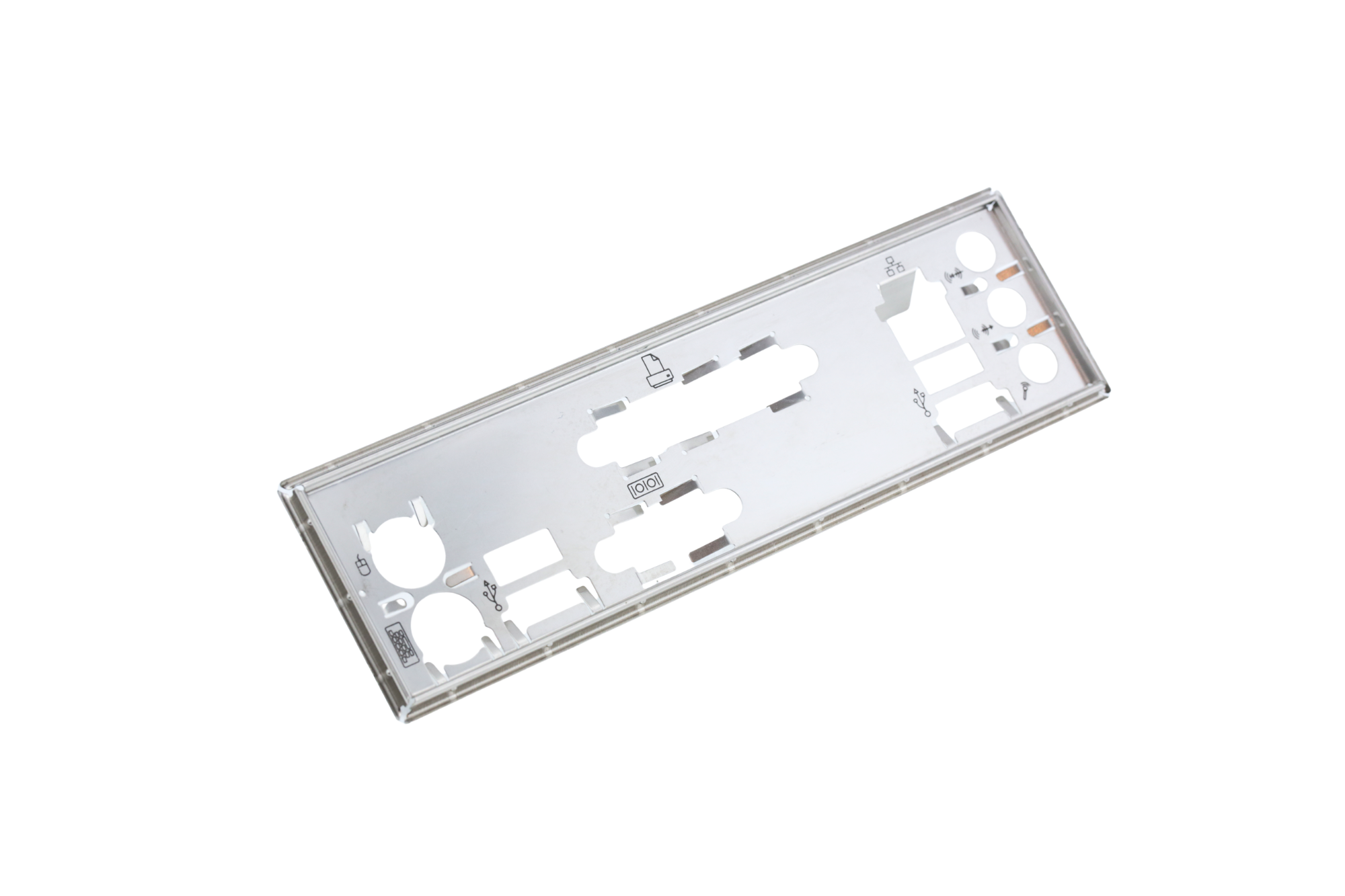
Product: PC I/O Shield
Services: Product Design & Engineering, Precision Metal Pressings, Design for Assembly, Prototyping, Tooling, High-Volume Manufacturing
Requirement: Develop a more efficient way of accommodating different motherboard connector layouts within PC chassis, reducing the need for chassis-specific rear-panel configurations, separate shield fasteners and additional assembly operations.
Outcome: A self-retaining pressed-metal I/O shield incorporating integrated retention and RF contact features, allowing different connector configurations to be installed within a common chassis aperture. More than six million units were subsequently manufactured across multiple variants.
PROJECT BENEFITS
- Allowed different motherboard connector layouts to use a common chassis aperture.
- Reduced the need to manufacture and stock multiple chassis rear-panel variants.
- Removed separate shield fasteners and reduced installation operations.
- Provided tactile confirmation that the shield was correctly seated.
- Maintained grounding continuity between connector shielding, the I/O shield and chassis.
- Supported cost-effective customisation and repeatable high-volume production.
- Scaled to more than six million units across multiple configurations.
Background:
As desktop PC architecture evolved, manufacturers needed to accommodate a growing number of external connections without multiplying the number of chassis configurations they produced and stocked.
Earlier systems often used ribbon cables to connect motherboard headers to separate sockets mounted in the enclosure. As the industry moved towards standardised motherboard form factors, including ATX, more interfaces were grouped into rear-mounted I/O clusters. This simplified the internal architecture, but different connector combinations still required different openings at the rear of the PC.
If those openings were formed directly in the enclosure, each motherboard layout could require a corresponding chassis rear panel. A more flexible approach was needed: the main chassis would retain a common aperture, while the variation for each connector layout would move into a smaller, lower-cost component.
Requirement:
The new I/O shield needed to allow different motherboard connector configurations to be accommodated within a common chassis aperture while maintaining the mechanical retention and electromagnetic shielding required around the rear I/O interface.
For high-volume manufacture, it also needed to minimise the number of separate components and assembly operations involved in installation.
The design therefore needed to:
- Install without separate screws or additional shield-fixing components.
- Accommodate normal manufacturing variation within the chassis aperture.
- Remain securely retained once installed.
- Maintain grounding continuity between the connector housings, shield and chassis.
- Support different motherboard connector layouts within the same fundamental chassis architecture.
- Reduce secondary fastening and assembly operations.
- Be straightforward to install in high-volume PC production environments.
- Support repeatable, cost-effective manufacture at scale.
Solution
DTI developed an innovative precision-pressed metal I/O shield incorporating retention and RF contact features directly into the metal component.
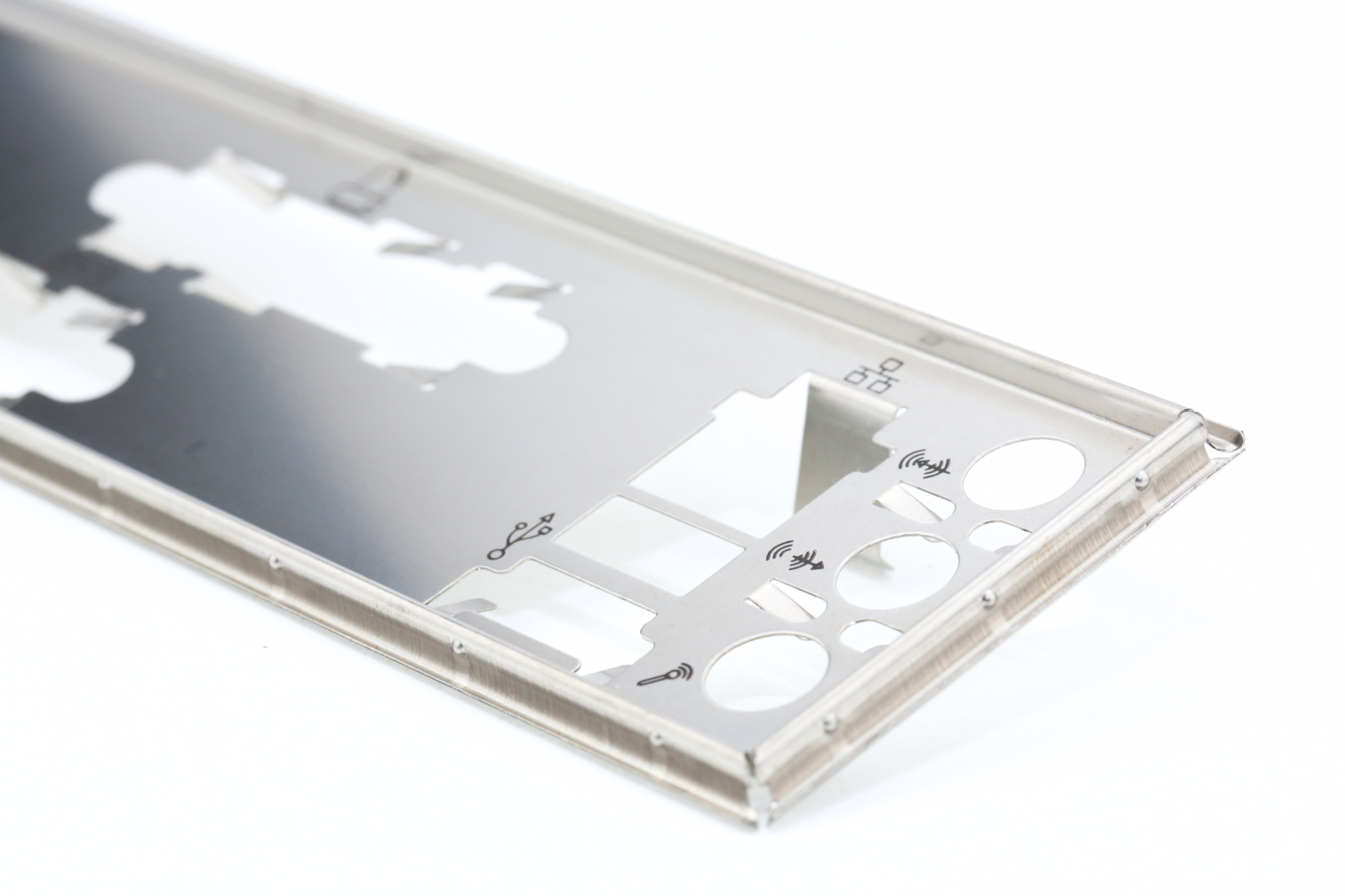
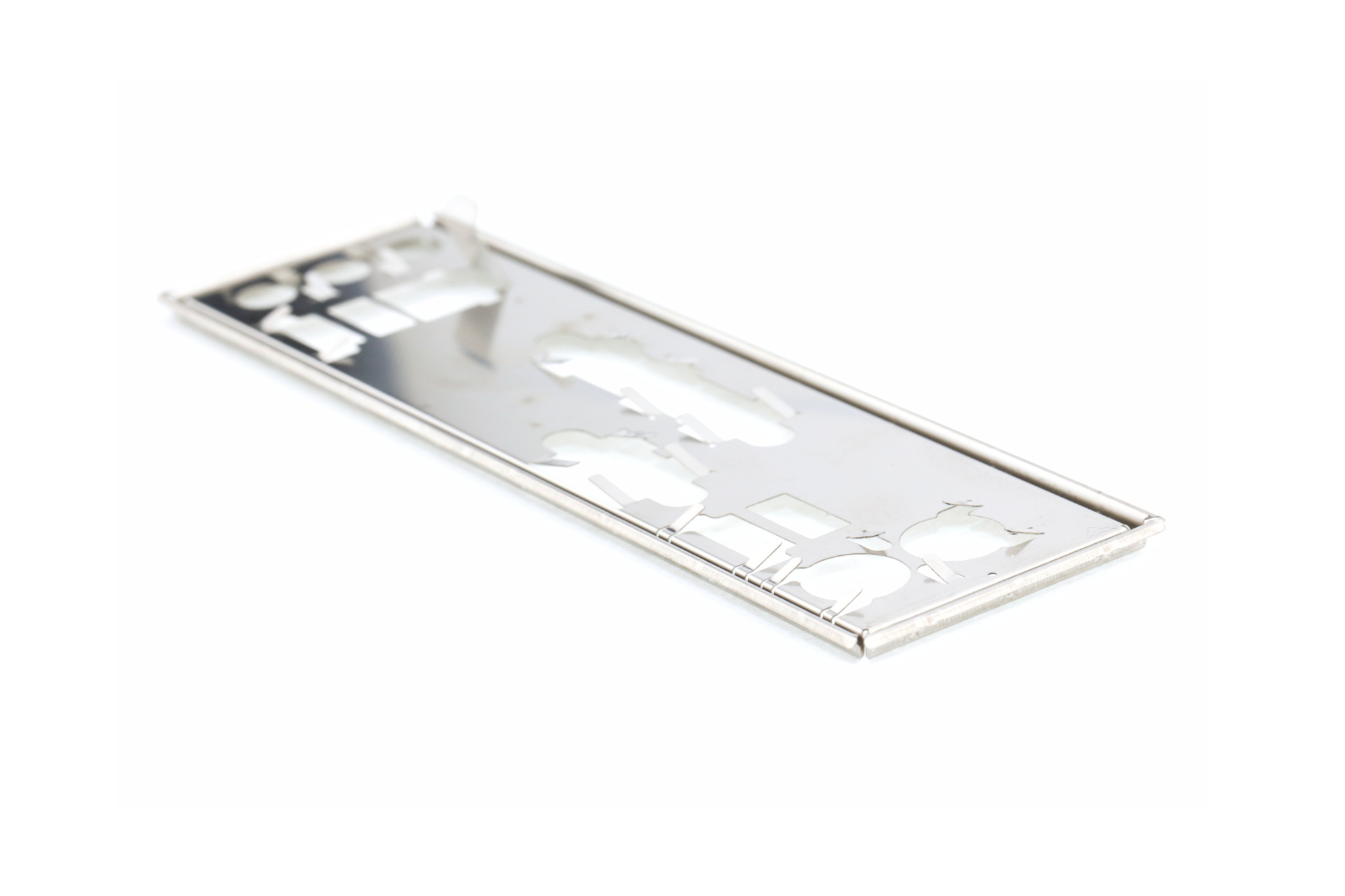
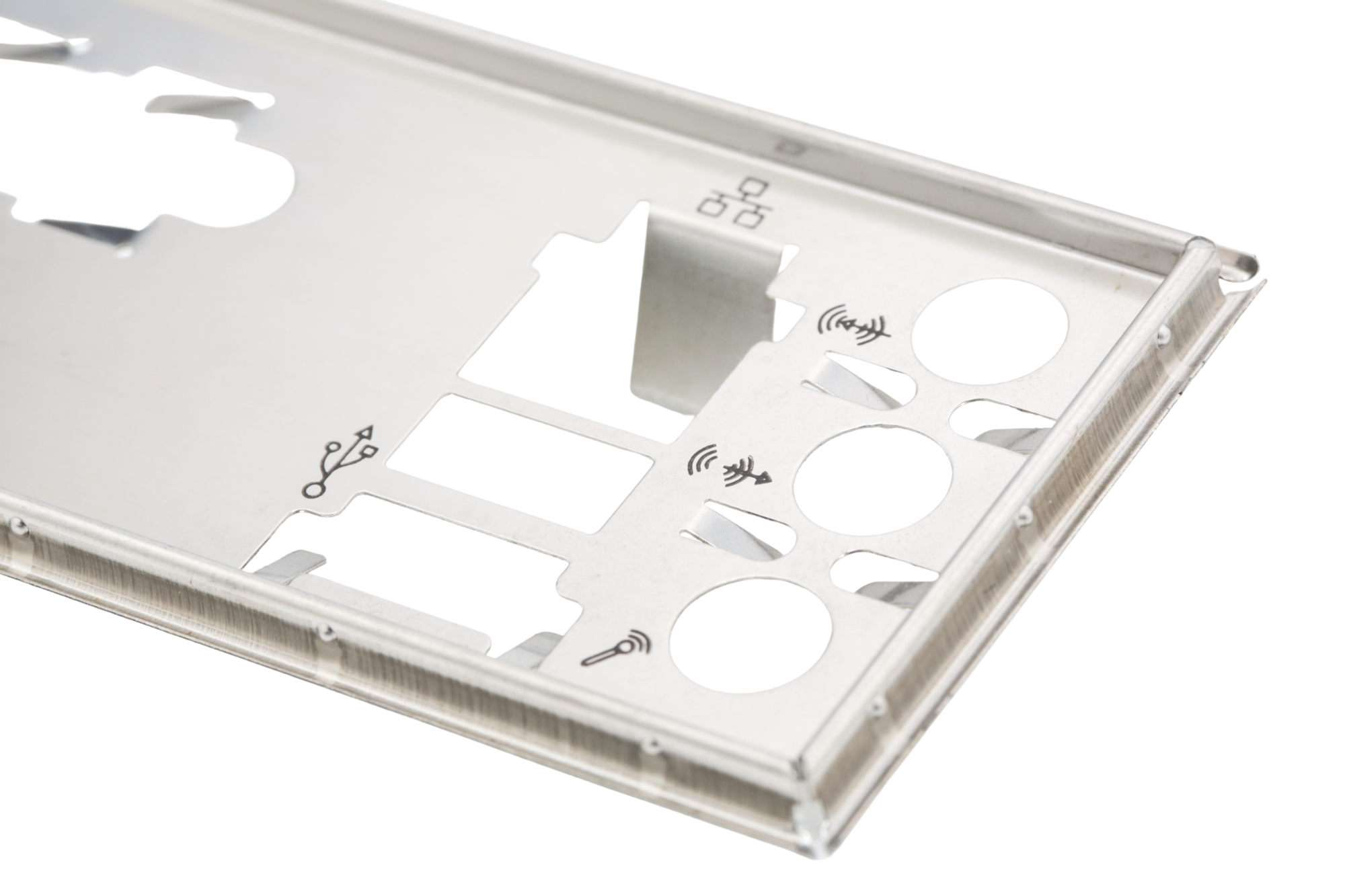
Raised retaining “pips” were formed around the perimeter of the shield to create controlled friction against the chassis aperture. These allowed the shield to clip securely into position without screws or separate retaining components.
The geometry of the pips provided sufficient retention while retaining enough compliance to accommodate normal dimensional variation within the chassis opening. This helped provide a consistent installation without requiring additional adjustment or fastening operations.
Pressed RF contact tabs were also incorporated around the connector apertures. When the motherboard was installed, these features provided contact with the conductive outer shells of the individual connectors, maintaining reliable grounding continuity between the connector shielding, I/O shield, and chassis to ensure full EMI/EMC compliance.
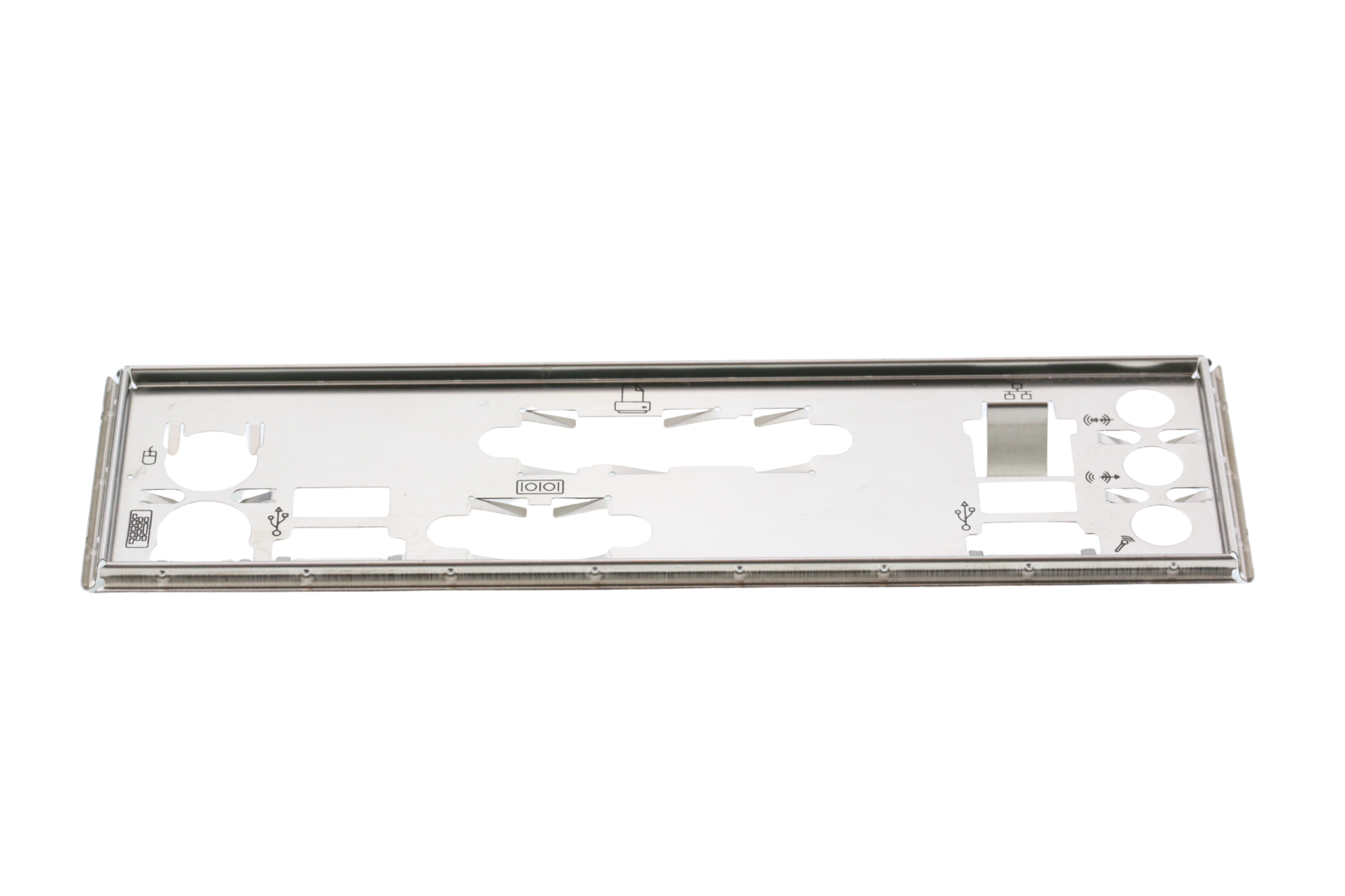
Integrating these functions directly into the pressing reduced the number of individual parts and assembly processes associated with the rear I/O interface.
More significantly, the connector layout could now be defined by the relatively small I/O shield rather than by the main PC enclosure. A common chassis aperture could therefore be retained across different system builds, with customised shield variants produced to suit different motherboard and connector configurations.
This transferred product variation away from the larger and more expensive chassis and into a component that could be manufactured economically using high-volume precision metal pressing.
Outcome:
The completed I/O shield provided PC and motherboard manufacturers with a more efficient way of supporting different system configurations without requiring corresponding changes to the main chassis.
Using a common rear aperture reduced the need to manufacture and stock multiple chassis variants for different motherboard connector layouts. Instead, the required variation could be incorporated into comparatively small, cost-effective I/O shields.
The integrated retaining pips removed separate shield fasteners and associated installation operations, while the RF contact features provided the required grounding connection between the connector shielding and chassis. This reduced component count, assembly time and manufacturing complexity.
The design could also be adapted to different connector arrangements without changing the underlying chassis interface, providing manufacturers with greater flexibility as motherboard configurations evolved.
The new design provided a dual function detent action and interference fit, offering a tactile “snap” upon insertion that gave assembly line workers immediate feedback that the shield was properly seated.
More than six million I/O shields were subsequently manufactured across multiple variants, demonstrating the scalability of the design and its suitability for high-volume production.
By reducing chassis variation, component count and assembly operations, the solution gave manufacturers a more efficient and cost-effective way of supporting an expanding range of PC configurations.
Get in touch today to discuss your next project
Whether you have a question, require more information, or want to discuss a potential project, our expert engineering and operations teams are on hand to help you.
We look forward to hearing from you and collaborating on innovative solutions for your business.
"*" indicates required fields